
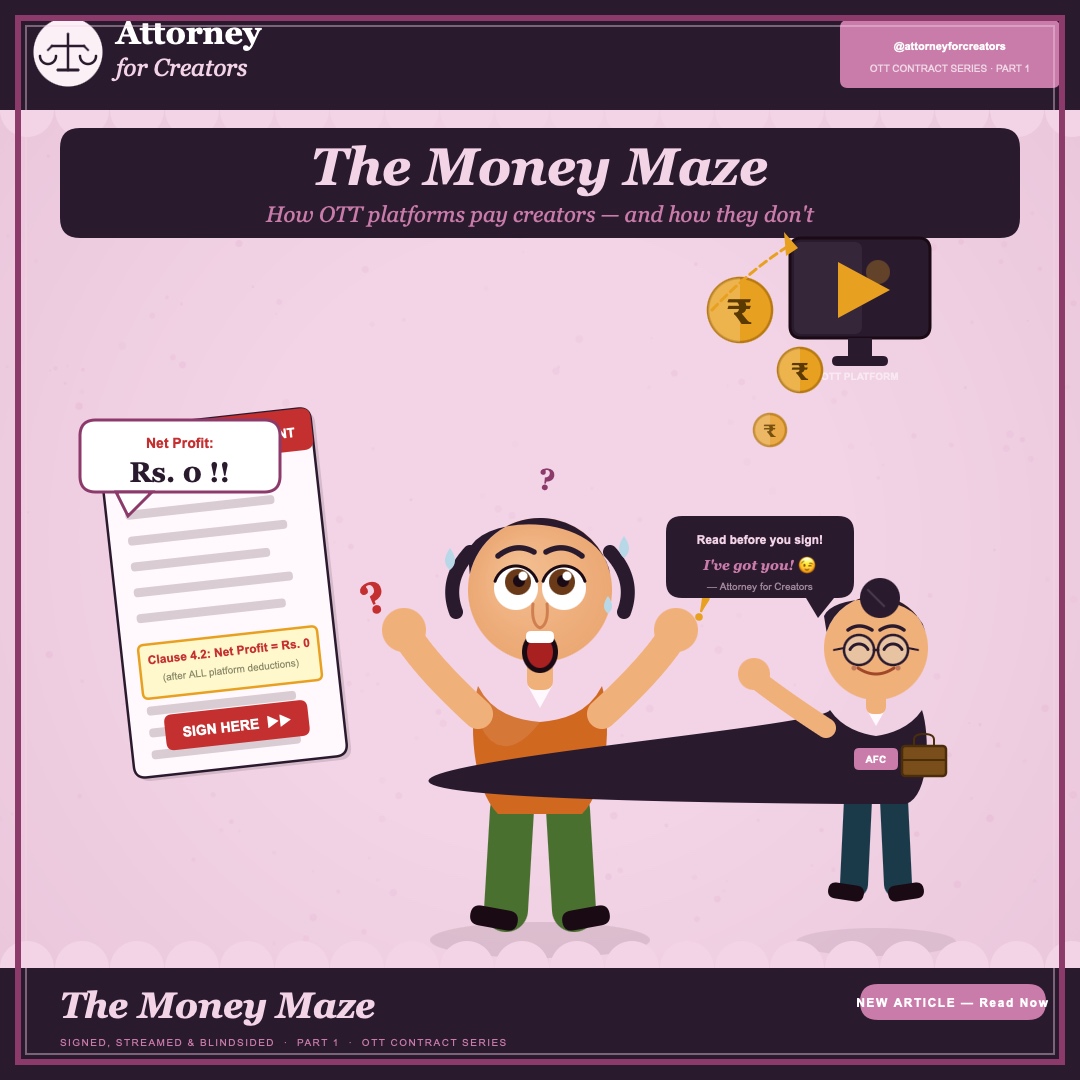
Signed, Streamed & Blindsided — Part 1 of the OTT Contract Series
Imagine this. A writer spends three years developing a crime thriller. The story is original, the characters feel alive, and the world she has built is unlike anything Indian audiences have seen. A production house picks it up. A big OTT platform comes on board. The show releases, the internet goes berserk, and the platform announces record viewership numbers.
Now here is the question nobody asks loudly enough. What did that writer actually take home?
When Sacred Games released on Netflix in 2018 and became India’s first truly global OTT success, it put Indian storytelling firmly on the world map. I am not suggesting anything about the specific contracts of anyone involved in that show. I genuinely do not know, and it would be wrong to assume. But the show’s extraordinary success does raise a question the industry quietly sidesteps even today. When something that big succeeds, who in the creative chain actually benefits financially?
From years of working with Indian creators, I can tell you that the answer is rarely the person who built the story. Not because platforms are villains, but because the contracts say what they say, and most creators sign without fully understanding them. That is what this series is about.
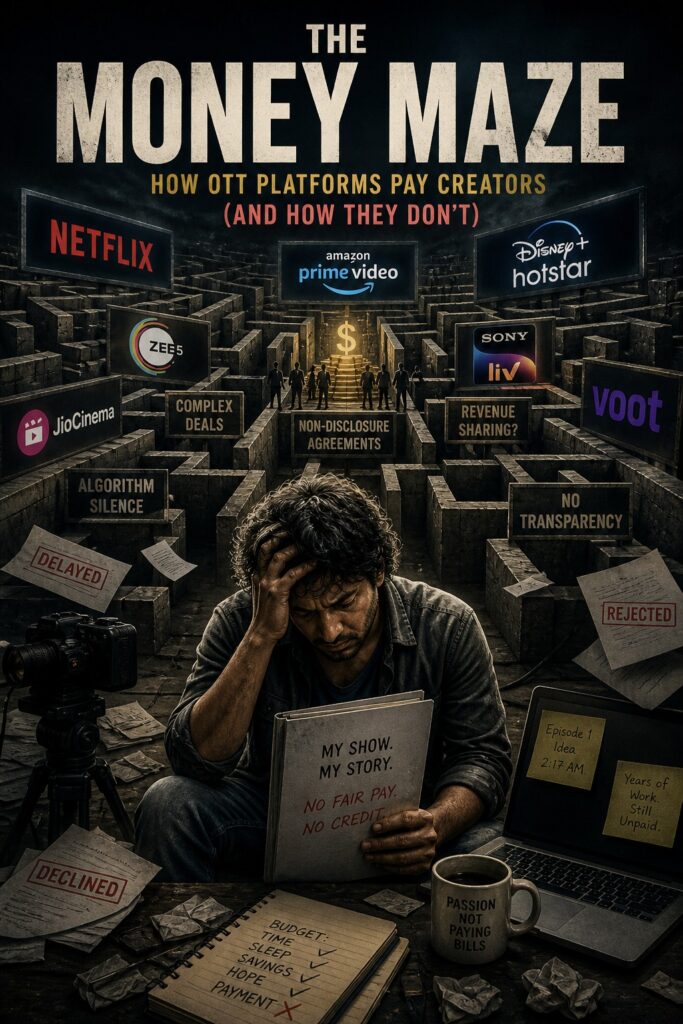
The Flat Fee Trap!
Most Indian OTT deals offer creators a fixed fee, a single lump sum for your script, direction, or production services. Your show then streams in 190 countries, gets renewed for three seasons, wins awards, and generates remake and merchandise deals. You receive none of that upside. The flat fee you accepted on day one is all you will ever see.
The flat fee feels generous at the moment. It is often the largest single payment a creator has received. And because the contract runs into dozens of pages, the clause that permanently disconnects you from future earnings sits quietly between definitions and schedules, easy to miss.
Before accepting any flat fee, ask your lawyer to negotiate a backend participation clause. This entitles you to a revenue share once the platform recoups its investment. It is not standard in Indian OTT contracts, but it is negotiable. Most creators simply never ask but if you have a bit of bargaining power with your spectacular records, you should use that bargain.
The Net Profit Illusion!
Some creators do manage to negotiate a revenue share. They feel like partners. Then the accounting statement arrives showing that despite millions of viewers, the “net profit” is zero.
This is creative accounting, and it is perfectly legal under most OTT contracts. The contract defines “net revenue” as whatever remains after the platform deducts its costs. Those costs are extensive: distribution charges, platform infrastructure fees, marketing expenses, international licensing costs. A show generating fifty crore rupees in viewership revenue can show zero net profit on paper after deductions, and the platform has technically done nothing wrong.
The protection here is to push for gross revenue participation rather than net, or at minimum, negotiate a closed and exhaustive list of permitted deductions. The word “revenue share” sounds fair. The definition buried three pages later is where your money disappears.
The Milestone Payment Trap!
Even your fixed fee rarely arrives in one payment. OTT contracts structure disbursements across milestones: a development fee at signing, production tranches during the shoot, and a final delivery payment once the platform “accepts” your content.
That word “accepts” carries serious risk. The contract will define delivery standards your work must meet before the platform formally accepts it. If they determine, for any reason, that delivery is incomplete, the final payment, which is usually the largest portion, can be withheld. I have seen creators who delivered exactly what was required spend months in disputes over “delivery standards” before receiving what they were owed.
Delivery requirements must be specific, objective, and mutually agreed upon before you sign. Any clause that ties your payment to the platform’s subjective satisfaction is a red flag.
The Right You Did Not Know You Had!
Here is what surprises most creators I speak to. Section 18(1) of the Copyright Act, 1957, as amended in 2012, gives authors and composers an inalienable right to receive royalties when their work is communicated to the public, including through OTT platforms. No contract can permanently extinguish this right.
The catch is that this right only works if you know it exists and are registered with the right societies. In India, the Indian Performing Right Society (IPRS) collects and distributes these royalties on behalf of lyricists and composers. Many creators are not registered, do not track what they are owed, and never receive what the law actually guarantees them. For Screenwriters, there is a newly registered copyright society namely Screenwriters Rights Association of India.
If you have licensed work to any OTT platform, this is worth an urgent conversation with your lawyer.
The Five Red Flags!
Before signing any OTT contract, these are the financial clauses that deserve the most scrutiny.
i) An open-ended deductions list in the definition of “net profit” is the first. If the contract uses phrases like “including but not limited to” when listing deductions, your revenue share can be reduced to zero at will.
ii) A delivery clause that ties your final payment to the platform’s subjective satisfaction is the second. Delivery standards must be objective, not discretionary.
iii) The absence of an audit right in any revenue share deal is the third. If you cannot verify the platform’s accounting, the revenue share is only as trustworthy as their goodwill. Practically, this clause is tough to negotiate in the case of Individual creators. However, if you are a production company (Independent Producer), you must negotiate this.
iv) A music rights clause that requires composers and lyricists to assign all rights with no royalty participation is the fourth. The 2012 amendment exists precisely to prevent this, yet it happens routinely.
v) The absence of any backend participation in a flat fee deal for high-potential content is the fifth. A flat fee on a show that becomes a cultural phenomenon is a trade you cannot undo.
A Final Word
OTT platforms have genuinely transformed Indian storytelling and invested seriously in Indian creative talent. This is not about distrust. It is about recognising that their contracts are drafted by experienced lawyers protecting their interests, and yours deserve the same protection.
Your story took years to write. Read the contract with the same seriousness before you sign it.
In Part 2 of this series, we will look at what an OTT platform can legally do to your content after delivery, including editing, dubbing, and making a sequel without you.
This article is for educational purposes only and does not constitute legal advice or opinion.
Is Your OTT Contract Working For You or Against You?
If you have a deal on the table or have already signed one, do not navigate it alone. At Attorney for Creators, we work specifically with writers, directors, composers, and producers who need practical, creator-focused legal guidance on entertainment contracts.
Book Your Consultation Session Here or Write us at legal@attorneyforcreators.com.
Let your creative work be protected as fiercely as it was created.


