There was a time when a screenwriter’s imagination was the only engine a story needed. A spark of emotion, a quiet night, a blank page, and the courage to start typing were enough to bring a world to life. But something is shifting in the creative universe. A new kind of storyteller has entered the room, one that doesn’t feel, doesn’t tire, and doesn’t wait for inspiration to strike. Artificial intelligence is here, and it is reshaping the way stories are born.
Imagine a writer named Rhea. She has spent years honing her craft, mastering dialogue and structure, chasing that perfect line that will make a character unforgettable. Her stories come from lived experience and imagination. Yet lately, she’s been hearing whispers. Producers are talking about AI that can draft a script in an afternoon, assistants who claim a machine can “write like Tarantino,” and investors who believe data can replace creativity. While Rhea still wrestles with a scene, somewhere an algorithm is spitting out ten story ideas at once. She can feel the world changing around her, and the question echoing in her mind is simple and terrifying. Will writers like me still matter?
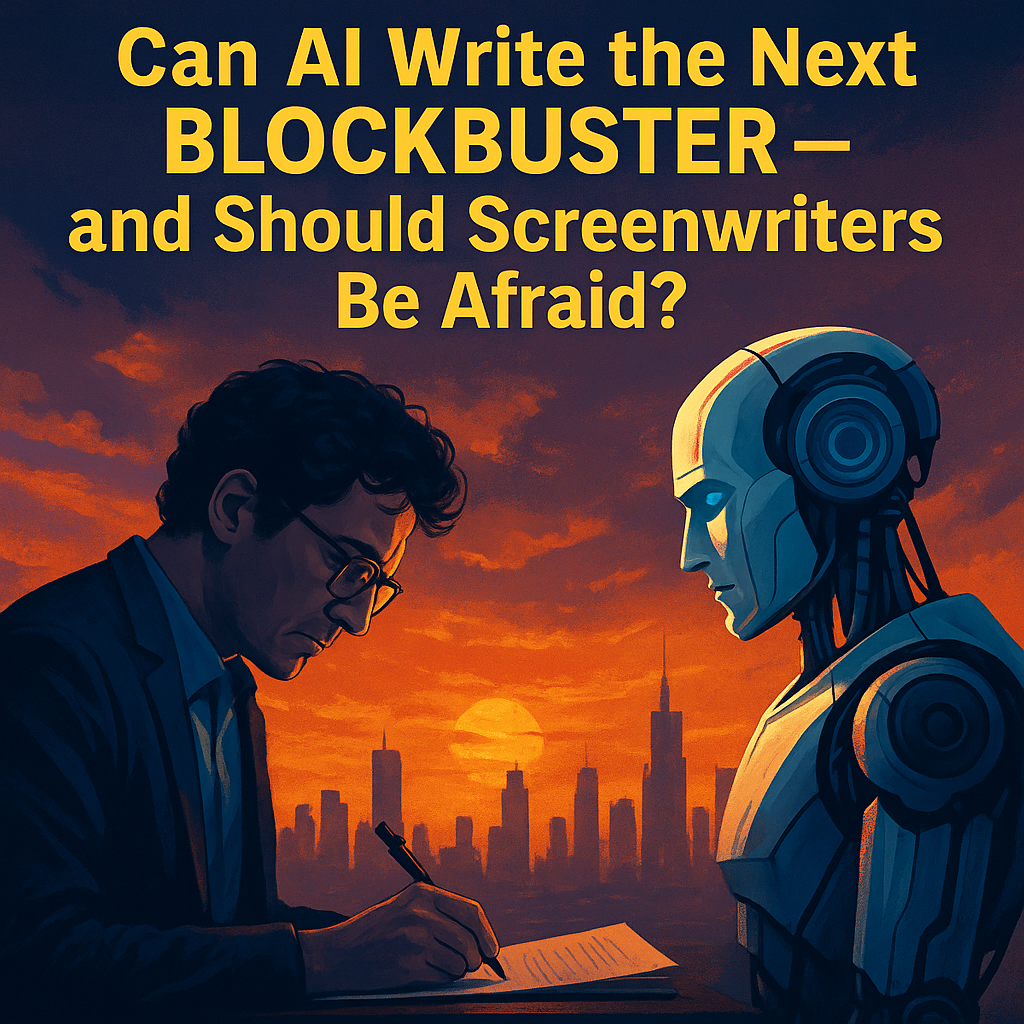
The truth is, AI is no longer something you can ignore. It is not a fad or a passing headline. It is becoming as essential as Final Draft once was, as fundamental as knowing how to format a screenplay. Writers who learn how to work with AI will not just survive this shift, they will thrive in it. Those who don’t may find themselves left behind in a business that rewards speed, adaptability, and fresh approaches to storytelling.
AI tools today can do astonishing things. ChatGPT, Claude, and Gemini can help a writer brainstorm ideas, sharpen dialogue, or create alternate endings in seconds. Sudowrite can step in when the words refuse to flow and push the imagination forward. Cinelytic and ScriptBook can analyze a screenplay’s potential before it ever reaches a producer’s desk. Runway and Synthesia can turn those words into moving images, offering a taste of what the final story could look like. Used well, these tools can expand a writer’s reach and efficiency in ways that were once impossible. They are not replacements for creativity but amplifiers of it.
But on the other side of this innovation lies a more unsettling possibility. Picture a producer sitting alone, typing into an AI tool a single prompt: “Write a screenplay like Inception meets Dune.” In minutes, a draft appears. No writer, no late-night revisions, no human touch. Some studios are already experimenting with AI-generated scripts, seduced by the promise of low cost and high speed. The idea that a story can be built by code and computation, without human involvement, is both thrilling and unnerving. Yet for all its power, AI still cannot imagine. It cannot dream of something entirely new. It learns from what already exists and predicts what should come next. It remembers patterns, it imitates emotion, but it cannot feel it.
A machine can simulate heartbreak, but only a human knows what heartbreak feels like. A human can take the silence between two people and turn it into dialogue that hurts in all the right ways. That is the one thing AI can never truly recreate. And that is why the most powerful writer of the future will not be the one who competes with AI but the one who collaborates with it. Together, human and machine can create faster, cleaner, and bolder work than ever before. Even a newcomer, with the right imagination and AI support, can now craft a professional-level script.
This partnership, however, opens up a legal Pandora’s box. If a writer uses AI to help create a screenplay, who owns it? The machine or the mind that guided it? Under Indian law, the answer remains rooted in human creativity. The Indian Copyright Act of 1957 recognizes an author as the person who causes a work to be created. That definition assumes intention and creativity — qualities AI cannot possess. So when a writer uses AI as a tool to refine their story or assist with structure, the copyright belongs to the writer. Their input, judgment, and artistic decisions remain the foundation of authorship.
The trouble begins when AI works entirely on its own. If a producer allows an AI to generate a complete script without any human input, the resulting story may not be protected by copyright at all. In India, only works created by a human author can receive protection. That means a fully AI-generated script might fall into a strange gray area — it exists, but it cannot be owned. Anyone could copy or modify it, and there would be no legal claim of infringement. It’s an eerie thought: a script that could go viral but belong to no one.
Ethically and practically, screenwriters should also consider disclosure. Should they tell a producer that AI assisted in the writing process? Increasingly, the answer is yes. Production houses and writer guilds around the world are beginning to require transparency when AI is involved. Not to punish innovation, but to maintain clarity in ownership, credit, and royalties. Writers should keep records of their creative process — notes, outlines, or even the prompts they used — to prove that the story is theirs. In law, what matters is authorship, and authorship is determined by human creativity, not machine output.
So, is AI a friend or foe to screenwriters? Perhaps it is both, and neither. Like fire, it can illuminate or destroy depending on who holds it. The danger is not that AI will replace the human writer, but that the human writer will refuse to evolve. The most exciting storytellers of tomorrow will not be those who shut the door on technology, but those who open it wide and step through fearlessly. They will write with heart, powered by code, merging imagination and intelligence into something the world has never seen before.
Because AI can predict what happens next. But only a human can decide why it matters.
For any legal query/consultation: Reach out to us at legal@attorneyforcreators.com, 9773878360