The Legal Plot Twist You Didn’t See Coming
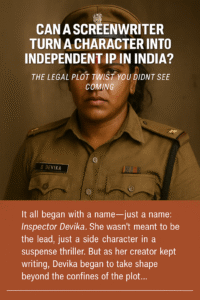
It all began with a name. Not a logline or a high-concept pitch—just a name: Inspector Devika. She wasn’t meant to be the lead, just a side character in a suspense thriller. But as her creator, Aanya, kept writing, Devika began to take shape beyond the confines of the plot. She had a sharp mind, a soft Bihari lilt in her speech, a meticulous approach to justice, and a quiet defiance born of years fighting her way up in a patriarchal system. By the time the script was finished, she had become the heart of the story. And yet, as producers began circling the project, Aanya was gripped by a crucial question: if she sold the script, would Devika still be hers? Could a screenwriter in India legally protect a fictional character as independent intellectual property? I have received this query from multiple screenwriters. In fact, I had spoken in length at this topic last year at Mumbai International Film Festival, where I was invited as a panellist.
For legal protection of a fictional character, Indian Copyright Act, 1957 doesn’t explicitly say “yes.” There’s no special provision for fictional characters as standalone IP. But Indian courts have, over the years, breathed nuance into the law. They’ve ruled that characters who are original, distinctive, and well-delineated—in other words, characters like Devika—can be protected under copyright. It’s not enough for a character to simply exist; she must exist in a way that’s undeniably herself—visually, psychologically, narratively.
This idea of “well-delineated” is the cornerstone of character copyrightability. It means the character must be more than a stock figure or generic type. Devika isn’t just “a female inspector”—she’s Inspector Devika: pragmatic, emotionally restrained, quietly empathetic, dressed in worn boots and crisp khakis, with a bindi on her forehead, always observing. Her mannerisms, speech patterns, and even the rituals she follows at her desk are part of what makes her distinctive. Indian courts have recognised that this level of characterisation crosses the threshold from idea to expression, and it’s the expression that copyright protects.
This was notably seen in Arbaaz Khan v. North Star Entertainment (2016), where the Bombay High Court acknowledged the copyrightability of Chulbul Pandey—another police officer character, but one with such a unique persona that the court viewed him as a protectable creation. Similarly, in Malayala Manorama v. V.T. Thomas, the Kerala High Court reinforced that a character, if originally developed and consistently portrayed, belongs to its creator—even if later commercialised by others.
So what does “well-delineated” really mean in legal terms? Think of it as a three-part test. First, the character must have specific and unique physical and personality traits. Second, she must be identifiable even outside her original context—Devika should feel like Devika, whether she’s in a web series, comic book, or audio series. Third, she should exhibit consistent expression, behaviours, and traits across her appearances. This is similar to the “Nichols Test” from U.S. case law, which has influenced Indian judicial thinking, even if not formally adopted.
There’s also the “story being told” standard, where courts have asked whether the character is so integral to the narrative that she essentially is the story. If you remove Devika from her script, do the plotlines collapse? If yes, then her centrality adds weight to her claim as protectable IP. Indian courts have echoed this logic: the more indispensable and richly developed a character is, the stronger the argument for copyright. Make note of this.
Practically, though, what should a screenwriter like Aanya do to protect Devika? First, she needs to document Devika thoroughly—in scripts, character bibles, artwork, and pitch decks. Copyright in India arises automatically upon creation, but formal registration provides strong legal evidence in disputes. This includes filing the necessary forms with the Copyright Office of India, particularly when scripts or artwork fix the character in tangible form.
Then there’s trademark protection. If Devika becomes part of a larger commercial venture—say, a merchandise line, a logo, or a spin-off series—Aanya can register her as a trademark under the Trade Marks Act, 1999. Courts in India have upheld such rights, most famously in Disney Enterprises Inc. v. Gurcharan Batra, where Disney’s characters were protected against unauthorised commercial use. For characters like Devika, whose brand potential might grow over time, this is a strategic move worth considering.
But none of these matters if ownership isn’t clear. If Aanya created Devika while under contract—say, working for a studio or production house—then her rights may be limited by that contract. Similarly, if she assigns her entire rights of her script to the production house then character automatically belong to the Production house. In India, work-for-hire rules often assign copyright to the producer unless otherwise stated. That’s why it’s vital for screenwriters to include precise clauses about character ownership in their agreements. If Aanya created Devika independently, she owns her. But once a producer gets involved, the legal landscape shifts—sometimes subtly, sometimes drastically.
Despite all these tools, India still doesn’t have a standalone statute that says, “Yes, fictional characters are protected IP.” Instead, creators must navigate a mix of copyright, trademark, and careful contract drafting, backed by evolving judicial interpretation. It’s a demanding system—but not an impossible one. The characters that get protected are the ones that stand out: layered, lived-in, and loved.
So yes, a screenwriter in India can turn a character like Devika into independent intellectual property. But it takes foresight. It takes legal strategy. And most importantly, it takes writing a character who refuses to be forgettable. Because when a character walks off the page and into our imagination, the law—eventually—takes notice.
For individual legal consultation and strategy preparation, reach our legal@attorneyforcreatos.com